
Search Colleges, Exams, Schools & more


Login
In Conversation with Professor Dinesh Kulkarni, Dean of DSU School of Design
Dayananda Sagar University, Bangalore was created by an Act of the Karnataka State in the year 2014. DSU is accredited by the NAAC and recognised by the University Grants Commission (UGC) and All India Council for Technical Education (AICTE). Dayananda Sagar University courses include BTech, BBA LLB, BPharm, BSc, BPT, MCA, MBA, MSc Pharm D and more.
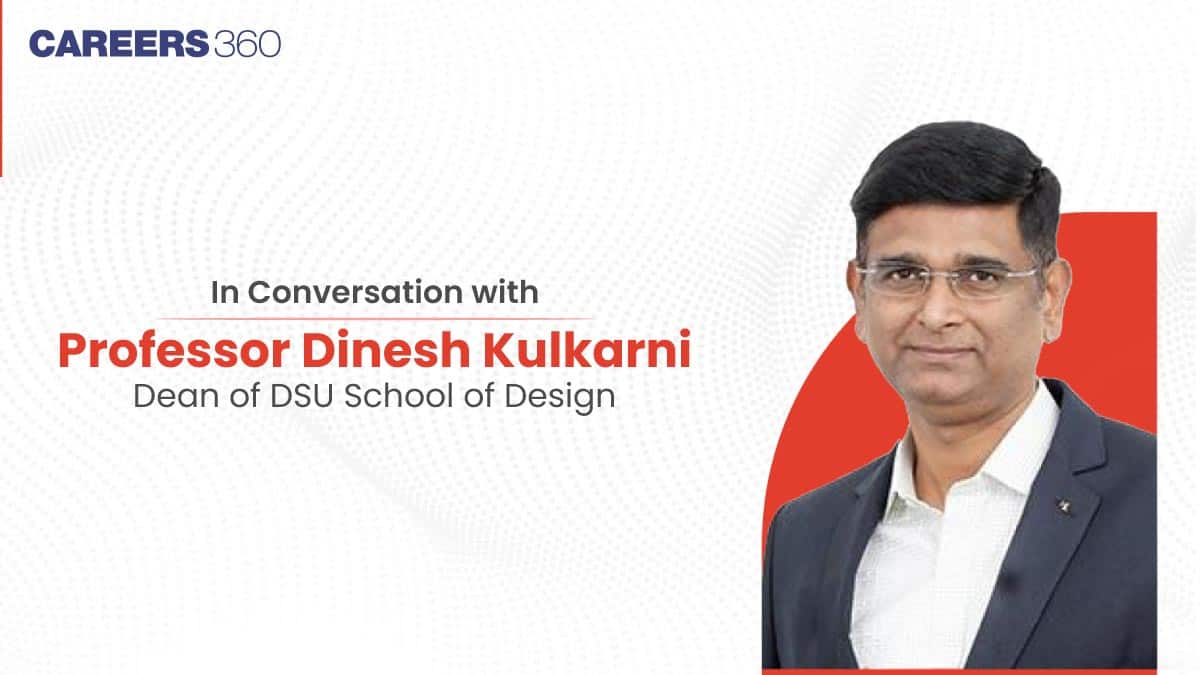
Careers360 presents you with an interview with Professor Dinesh Kulkarni, who is a professor & Dean of School of Design at DSU University. He enlightens you about the USPs of the campus, programmes offered and its specialisation and facilities available at DSU Bangalore, and the selection criteria of the programmes. To know more, go through the interview.
Also See: DSU Bangalore Admissions
Careers360: When was the DSU School of Design founded, and how would you describe its growth so far?
Prof. Dinesh Kulkarni: The School of Design & Digital Transmedia at DSU was launched in 2021, with its Bachelor of Design (B.Des.) programme introduced as part of the university’s expanding academic portfolio in creative disciplines, including Product Design, UX Design, Animation & VFX, and Game Design.
Careers360: What are the different programmes offered under DSU School of Design?
Prof. Dinesh Kulkarni: The Dayananda Sagar University (DSU) School of Design & Digital Transmedia offers a focused set of undergraduate design programs under the Bachelor of Design (B.Des.) degree. These programs are designed to develop creative and industry-ready skills in both physical and digital design disciplines. Programmes Offered (B.Des. – 4-Year Full-Time).
B.Des. – Product Design
Focuses on designing physical products, ergonomics, CAD, 3D printing, and innovation in tangible goods and systems.
B.Des. – User Experience Design
Emphasizes user research, interface design, usability, interaction design, and experience creation across digital platforms.
B.Des. – Animation and VFX
Covers animation principles, 2D/3D animation, visual effects, motion graphics, AR/VR basics, and storytelling for film and media.
B.Des. – Game Design
Centers on game art, game mechanics, narrative design, programming fundamentals, and interactive entertainment system development. These programs are structured to combine creative thinking, technology tools, and real-world project work, and are part of DSU’s strategy to prepare students for careers in product design, digital media, animation, gaming, and related industries.
Careers360: What does the admission journey look like, and which criteria matter most?
Prof. Dinesh Kulkarni: To be eligible for admission to the B.Design program at Dayananda Sagar University, you must meet one of the following criteria: 10+2 Qualification. Passed Class 12 (10+2) or equivalent from a recognized board in any stream (Science / Commerce / Arts / Humanities) Minimum 50% aggregate marks in 10+2 English must be a mandatory subject in your Class 12 qualification.
Careers360: How does the curriculum integrate experiential learning and practical training in design programmes?
Prof. Dinesh Kulkarni: Students graduate with strong portfolios, practical skills, industry exposure, and the confidence to contribute from day one.
Design curricula integrate experiential learning and practical training by placing learning-by-doing at the center of education. Instead of treating theory and practice separately, the curriculum is structured so that concepts are immediately applied in real contexts. Key Ways Experiential Learning Is Integrated.
Studio-Based Learning
Core subjects are taught through design studios rather than lecture-only formats
Students work on open-ended briefs, prototypes, and iterative design solutions
Faculty act as mentors and critics, simulating professional design environments
Project-Driven Curriculum
Every semester includes hands-on projects aligned with real-world problems
Projects progress from foundational exercises to complex, industry-scale challenges
Emphasis on research, ideation, execution, testing, and refinement
Industry Interaction & Live Briefs
Collaboration with industry partners through live projects and case studies
Guest lectures, workshops, and critiques by practicing designers and technologists
Exposure to real timelines, client expectations, and professional standards
Prototyping, Labs & Maker Spaces
Access to design labs, fabrication workshops, animation/VFX studios, UX labs, and game labs
Students build physical and digital prototypes using professional tools and pipelines
Encourages experimentation, failure, and rapid iteration
Internships & Field Immersion
Mandatory internships, apprenticeships, or industry immersion programs
On-site learning in studios, startups, design firms, or production houses
Helps students transition smoothly from academic to professional environments
Design Reviews & Critiques
Regular juries, critiques, and portfolio reviews
Students learn to articulate design decisions and receive structured feedback
Develops confidence, communication, and reflective thinking
Interdisciplinary Collaboration
Projects involve students from product design, UX, animation, gaming, and technology
Mirrors real-world cross-functional teamwork
Portfolio-Centric Assessment
Evaluation based on portfolios, prototypes, process documentation, and outcomes
Focus on growth, originality, and problem-solving rather than rote exams
Careers360: How is artificial intelligence influencing design education, and in what ways has DSU School of Design adapted to this?
Prof. Dinesh Kulkarni: AI in design education empowers students with new tools for ideation, prototyping, personalization, and real-time feedback while strengthening their creative judgment. At DSU’s School of Design & Digital Transmedia, this influence shows up through inclusion of intelligent system design in curriculum, integration of AI-adjacent technologies like AR/VR, and ongoing experiential learning that prepares students for the future of design.
AI influences design education by:
Augmenting, not replacing, creativity: AI supports idea generation and iteration but designers still guide creative intent.
Expanding skill sets: Students gain experience with intelligent systems, interactive experiences (AR/VR), and data-informed design decisions.
Preparing for future roles: Designers are expected to be fluent with AI tools, user analytics, adaptive interfaces, and smart product thinking.
Careers360: How does DSU School of Design integrate global best practices with local relevance in its academic and training approach?
Prof. Dinesh Kulkarni:
a) Emerging Technologies in Curriculum
The B.Des programs at DSU include emerging technologies such as AI, AR, and VR as integral parts of design problem-solving and innovation, ensuring students work with modern digital tools in projects and studios.
b) Applied Projects Using Intelligent Systems
Courses like Product Design explicitly mention design of intelligent products, suggesting that students learn to embed AI-influenced features (e.g., smart interfaces, sensor-based systems) into user-centric solutions.
c) Exposure to AR/VR and Advanced Prototyping
Programs in animation, UX, and game design include augmented and virtual reality, areas where AI often intersects with immersive experience design—giving students practical exposure to cutting-edge design computing.
Careers360: Does DSU School of Design offer international exposure through collaborations, exchanges, or global design platforms?
Prof. Dinesh Kulkarni: Study Abroad & Master’s Opportunities The university facilitates study-abroad pathways and guidance for students interested in pursuing advanced degrees overseas, helping them prepare for global academic and cultural immersion.
International Immersion & Bootcamps
Programs like International Immersion, Bootcamps for Innovators, and International Robotics Initiative offer students cross-cultural experiences, hands-on global learning activities, and exposure to international best practices in innovation and technology through centre of excellence established at Harohalli campus
Conferences & Collaborative Projects
DSU participates in international academic events and conferences, providing platforms for students and faculty to engage with global peers, present work, and learn from experts from around the world.
Careers360: Are summer internships compulsory for third-year students? How does the School of Design prepare students to face the realities and challenges of the dynamic media industry?
Prof. Dinesh Kulkarni: Summer internships are a compulsory bridge between academic learning and industry practice, while the School’s combination of technology, studio work, mentorship, and professional development ensures that graduates are equipped to thrive in the dynamic, fast-evolving media and design ecosystem.
Studio & Project-Based Learning
Students work in design studios and labs mirroring professional environments.
Collaborative and interdisciplinary projects teach teamwork, time management, and problem-solving.
Exposure to Industry Mentors
Faculty include practicing designers and media professionals.
Guest lectures, workshops, and masterclasses expose students to current industry practices and trends.
Portfolio & Capstone Projects
Final-year capstone projects tackle real industry challenges, often in collaboration with corporate partners.
Builds confidence in idea generation, execution, and client presentation.
Careers360: How can aspiring designers equip themselves with the skills needed to keep pace with new industry trends?
Prof. Dinesh Kulkarni: Aspiring designers must combine creativity with technology, theory with practice, and curiosity with discipline. Those who adapt, experiment, and continually learn will stay ahead in the dynamic media and design industry.
Master Core Design Principles
Strong foundation in visual communication, color theory, typography, form, and composition.
Understanding human-centered design and user experience fundamentals.
Ability to apply principles across mediums: print, digital, AR/VR, gaming, and motion graphics.
Develop Technical & Digital Skills
Design software proficiency: Adobe Creative Suite, Figma, Sketch, Blender, Maya, Unity/Unreal Engine.
Emerging technologies: AI-assisted design tools, AR/VR, motion capture, 3D stereoscopy, and interactive media.
Rapid prototyping & iteration: Learn to move quickly from concept to testable
Cultivate Creativity and Innovation
Engage in side projects, personal experiments, and concept development.
Explore cross-disciplinary ideas from art, technology, science, and culture.
Build a habit of ideation and divergent thinking to solve complex design challenges.
Gain Industry Exposure
Participate in internships, live projects, and workshops.
Collaborate on real-world briefs to understand constraints, timelines, and client expectations.
Attend industry conferences, hackathons, and design sprints.
Build a Strong Portfolio
Document process, iterations, and learnings, not just final outputs.
Include diverse projects to show adaptability across media and platforms.
Maintain digital portfolios to stay visible to recruiters, clients, and collaborators.
Stay Informed About Trends
Follow global design platforms, blogs, and journals (e.g., Behance, Dribbble, Fast Company Design, AIGA).
Track developments in UX, AR/VR, AI, gaming, media, and product design.
Learn emerging practices in sustainability, inclusive design, and experiential storytelling.
Engage in Lifelong Learning
Take online courses, certifications, and workshops to update technical knowledge.
Participate in peer learning communities and mentorship programs.
Experiment with new tools and creative approaches regularly.
Careers360: What future roadmap do you see for DSU School of Design in shaping the next generation of designers?
Prof. Dinesh Kulkarni: As India’s shift from a services-led to a product-led economy:
India is evolving up the value chain, not abandoning services. Decades of IT and services work have built deep technical and domain expertise, which is now enabling product creation, IP ownership, and global brands.
Key drivers include:
Mature talent with end-to-end product exposure
Digital public infrastructure (India Stack) lowering startup friction
Growth of product startups in SaaS, fintech, deep tech, gaming, and media
Government push toward design + manufacturing (Make in India, PLI)
Rising importance of design, UX, branding, and original IP
The mindset is shifting from client-driven execution to user-driven innovation, though challenges like risk aversion and limited patient capital remain. In essence: India is using its services strength as a springboard to build scalable products, intellectual property, and global competitiveness.
Leadership Philosophy
“Students flourish when taught by practitioners, guided by design thinking, and challenged to push creative and technological boundaries.”
Profile Summary
Senior academic and industry leader with 30 years of experience across Media, Animation, VFX, AR/VR, 3D Stereoscopy, and Original IP creation. Proven track record in building institutions, scaling education verticals, and aligning academia with industry demand. Known for translating emerging technologies into future-ready academic programs, driving high student employability and sustainable revenue growth. A strategic, multilingual leader with deep expertise in curriculum innovation, transmedia storytelling, faculty leadership, and industry partnerships. Passionate about design thinking, quality-driven skill development, and creating ecosystems where students and institutions thrive.
Leadership Highlights
Established and led 15 university campuses, managing academics, BOS approvals, and administration
Designed and launched 10+ undergraduate and postgraduate programs in Animation, VFX, Gaming, Digital Filmmaking, UI/UX and Product Design
Dean & Professor of Practice leading Design and Digital Transmedia strategy at a premier university
Co-founded industry-led training models ensuring production-ready graduate from day one Implemented 3D Stereoscopy and emerging technologies AR/VR across content production and education
Secured equity funding and optimized studio operations through SEZ implementation
Delivered national and international projects for Hollywood, Broadcast Networks, and Digital Platforms Projects include: Resident Evil: Afterlife, Hanna, Three Musketeers, Little Krishna Series
Pioneered cost-effective 3D Stereoscopy in Indian animation pipelines
Developed original IP, political caricature series, documentaries, and low-cost animation formats
Strong engagement with broadcast networks, OTT ecosystems, and transmedia platforms
Disclaimer: This content was distributed by DSU School of Design and has been published as part of Careers360’s marketing initiative.
Articles
Upcoming Design Exams

Certifications By Top Providers
Explore Top Universities Across Globe
List of Related colleges
Questions related to DSU Bangalore
On Question asked by student community
Have a question related to DSU Bangalore ?
Dear aspirant hope you are doing well..
DSU Bangalore Fee Structure and List of Courses Summary
Course :Duration : Fees
- B.Com [Bachelor of Commerce] :3 Years : 2.55 Lakh
- B.Sc [Bachelor of Science] :4 Years: 2.97 Lakh
- B.Tech [Bachelor of Technology] :4 Years : 7.98 Lakh
- MBA [Master of Business
Hi aspirant,
Dayanand Sagar University is one of the private Engineering colleges located in Bangalore, Karnataka. The university offers various courses in BTech and the most demanded of which is Computer Science and Engineering. The fee structure for the same is around 1.2 lacs per annum that rounds to 4.8
Hi aspirant, based on your question below is your answer;
The following is a list of core subjects covered in the BSc Biotechnology syllabus:
- Introductory Biological Chemistry.
- Animal and Plant Physiology.
- Recombinant DNA Technology.
- DNA Typing, Proteomics and Beyond.
- Biodiversity and Taxonomy.
- Microbiology and Macromolecule.
- Biostatistics
Thank You.
Isjsjsiaksuwkaksksjkqkskqiiskalalsoslslwksisosiwiwososoeisowis
Hello,
As you not mentioned your category so consider it as general.
So in 31963 rank in COMEDK 2021 you don't get CSE in Dayananda Sagar College of Engineering, Bangalore.
But if you chose another branch you have good chance to get Dayananda Sagar College of Engineering, Bangalore.
For cut

Applications for Admissions are open.
Ranked #45 amongst Universities in India by NIRF | Get Upto 100% Scholarships | Spot Admissions via CUET
Indian Institute of Art and Design, New Delhi
ApplyLeading Design College | 95% Placement Record | Merit-cum-Means Scholarships for Deserving Students
Pearl Academy, South Delhi Campus, New Delhi
ApplyGet up to 100% scholarship on B.Des. & BBA admissions through your CUET-UG score | No. 1 Design & Fashion Institute by ASSOCHAM, India Today, Outlook and The Week rankings
Woxsen University, Hyderabad
ApplyScholars’ Round Deadline: 14th Nov’26 | Earn upto 50% merit Scholarship + 10% for top performers | EFMD Accredited | AACSB (USA) & AMDISA Member | Highest CTC 28 LPA
Unitedworld Institute of Design, Ahmedabad
Apply1200+ Recruiters for Placements | 30+ International Collaborations | 45+ Advanced Labs and Studios
ITM Institute of Design and Media, Andheri Campus, Mumbai
ApplyFaculty from A+ Design schools of India and Abroad | 100% Placement Assistance