School of Design, UPES, Dehradun
Ranked #45 amongst Universities in India by NIRF | Get Upto 100% Scholarships | Spot Admissions via CUET


For any working professional time which is most scarce is the most valuable asset, and devoting this currency into preparation for higher education for a better future of your interest like NID PG Entrance Examination is a strategic decision with a 9-to-5 job.
This commitment of yours would demand a structured, highly clinical and resulted oriented preparation strategy. Below we have provided a structured breakdown of preparation strategy, designed to embrace your needs tailored to accommodate your fast paced life.
So, let’s begin with asking the right questions.
Broadly the NID M.Des 2027 exam can be overviewed in the 03 stages according to the NID DAT Exam Pattern as follows:
STAGE | EXAM LEVEL | FOCUS AREA |
Stage 01 : Screening | Prelims ( Conducted by NID independently across more than 17 centres across India) | Clearing the cut-off and focussed heavily on Design Aptitude. |
Stage 02 : Practical | Mains (Studio Test and Practical Round) | 3D-Modelling, Problem Solving and Sensory Assessment |
Stage 03 : Interview and Portfolio Round | Interview ( Panelist checking interpersonal skills) | Portfolio Presentation, Interaction on your work and current experience, Psychometric Evaluation is passively done during conversation |
The exam pattern and objective at each stage keeps updating time to time with the evolving needs of industry
Students should also check:
With your work routine it becomes critical dividing the preparation journey into three strategic phases balancing the work and study:
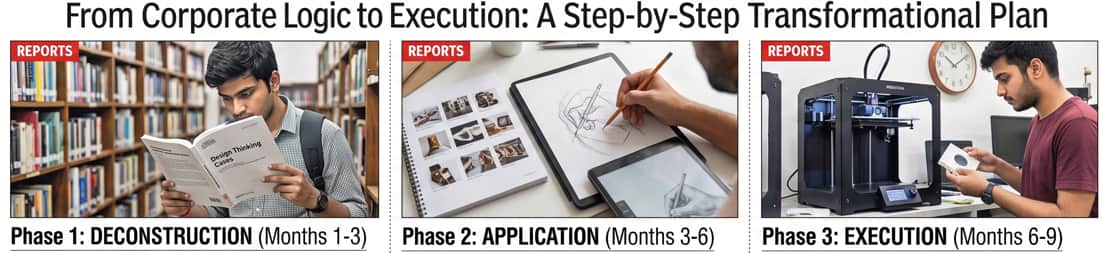
Deconstruction (Month 1-3) : Shifting from your corporate logic to Design thinking by engaging in activities like Daily reading(Design case studies), Solving Previous year papers and building the new knowledge over the old.
Ranked #45 amongst Universities in India by NIRF | Get Upto 100% Scholarships | Spot Admissions via CUET
Application (Month 3-6) : Increasing the intensity with rapid sketching, balancing proportions and Documenting the existing works into a design portfolio.
Execution (Month 6-9) : Focussed on time bounded paper solving to material manipulation, practising mocks and testing the skills.
Creative exams like NID, look for the cognitive ability with artistic expression in a candidate, here is the strategy to relooking the various sections apart from your routines:
Section | Preparation Strategy with examples for Professionals |
Visual and Spatial Ability | Your preparation journey should be focussed on developing mental skills like rotation, transforming the views from 2D to 3D and vice-versa. |
Design Sensitivity through Observation | This demands for developing an eye for everyday challenges and arresting the cause to your disposal as a “Design Brief” |
Design Problem Solving Skills | Design problems are no different from other opportunity of making a little better in your everyday interactions |
General Knowledge and Design Awareness | Read the basics concepts of physics/mechanics, case studies of good and Bad design and history. |
You are about to enter the world of rapid communication where your unique sketching style is your skill to Communicate in less:
The Requirement | Application of | Justification |
| Primary Skill : Precision and Drafting | Demonstrate your understanding for production and manufacturing with line weight and variation for different objectives. |
User Interaction Frames | This should include the quick gestural interacting with an object in sequence. | This depicts your capacity to empathise with human-centric thinking and technical understanding like ergonomics. |
Spatial Transitions : Like Perspective view from Extremes | Producing the view of a bottle with reflective surface from the POV of a an ant(extreme upside view) | NID recently has started giving challenging visual questions that demand for such observation right from prelims, where accuracy, observation and technical understanding are tested practically. |
Rendering Details for basic material like metals, wood , rubber etc. | Look and try to mimic the textures of everyday material like reflections of objects on a tumbler surface. | Note: Rendering means basic rendering to communicate the intent but not an artistic view, which would be a waste of time. |
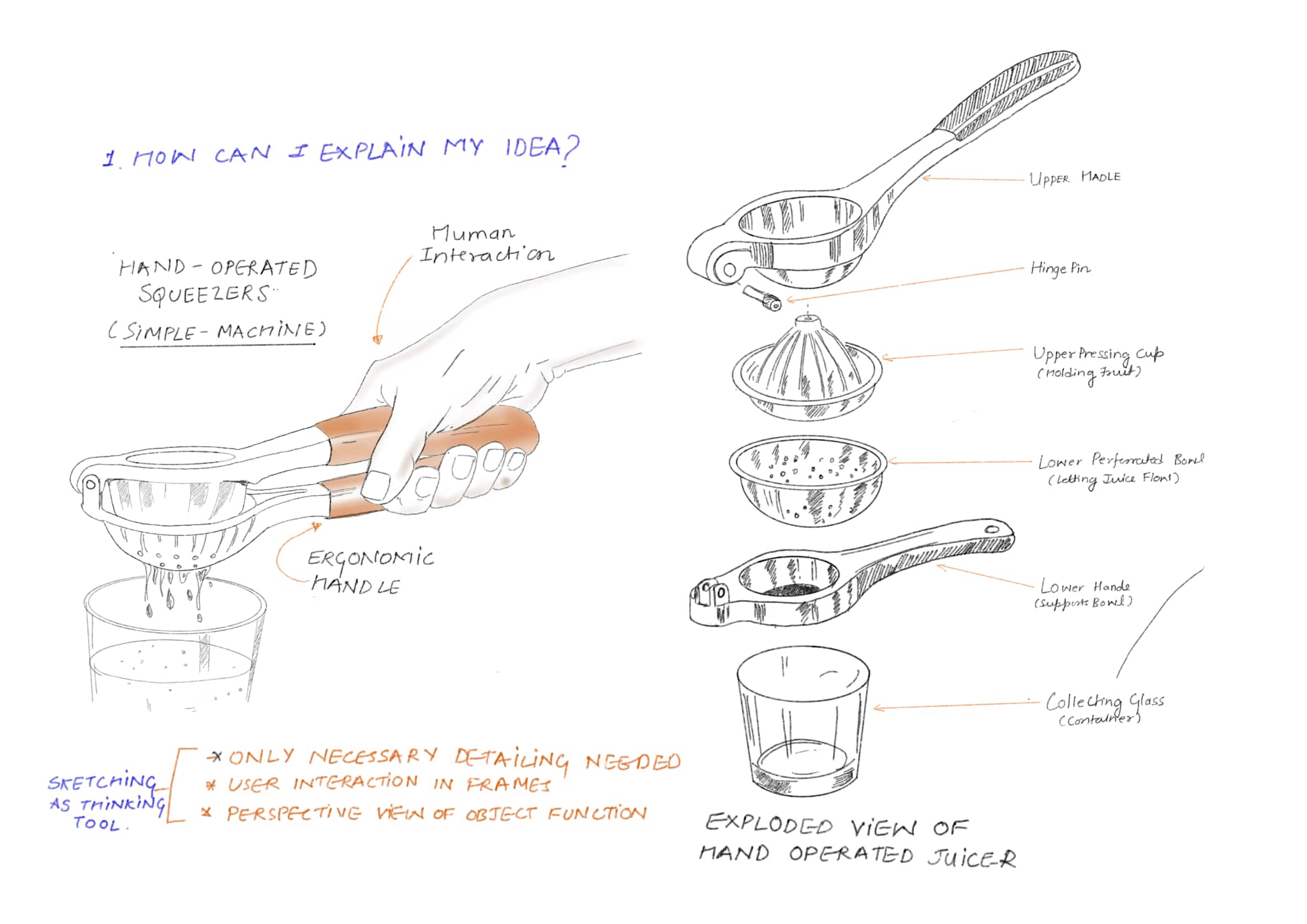
Let’s try to understand the application of using the Sketching as a Thinking Tool” viz. An example of a hand pressed juicer, as shown below with all above requirements bundled into a clear ideation.
Students are also advised to check:
It’s true that you have less time for preparations than other students(focussed on preparation), but you have the leverage with your own skillsets from professional exposure and unique array of challenges you see and have overcome with right aptitude.
Professional Background | Portfolio | Unique |
*Engineering/ IT | You can talk about your UI/US study systems, hardware prototypes, ISO standards, Problem-Solving Processes | “ I have the knowledge of building scalable systems, where at NID i can integrate th human-centric learnings for rigid design frameworks” |
*Architecture | Showcase your work for Space Design, Client Projects, Structural Challenges, Sustainability and Material challenges | “ I design spaces that speak with customer satisfaction and with design i can design sand scale this to systems” |
* Hand Illustrator | You can present your work form communication, branding, storytelling and business challenges | “ I have the unique ability to communicate the complex ideas, where wish to scale from aesthetics to leading design strategy” |
*Business | Service design blueprints, Practical Journey Maps and Funnel of customer onboarding, Work Flow Optimisation etc. | “I understand the business viability and blending this with design process will make them desirable and commercially scalable" |
Determined to appear in the NID M.Des. 2027 for an upgrade in career as a working professional, congratulations the half journey is done with this thought. Now through finer polishing, unlearning and rapidly evolving with the above strategy, transform this wish into reality. Show your acquired skill, corporate-backed problem solving to secure a well-deserved seat in one of the premier colleges of India.
Related Articles:

On Question asked by student community
No, the NID DAT Prelims paper is not exactly the same for B.Des and M.Des aspirants.
You can check these resources for more clarity:
https://design.careers360.com/articles/nid-dat-sample-papers
https://design.careers360.com/articles/nid-mdes-previous-year-question-papers-with-solution

Ranked #45 amongst Universities in India by NIRF | Get Upto 100% Scholarships | Spot Admissions via CUET