Indian Institute of Art and Design, New Delhi
Leading Design College | 95% Placement Record | Merit-cum-Means Scholarships for Deserving Students


IIT Bombay conducts the Undergraduate Common Entrance Exam for Design for admission into B.Des programmes of participating IITs. The goal of the comprehensive and well-rounded UCEED entrance exam is to identify candidates who have exceptional design skills in addition to critical thinking and creative problem-solving abilities. Its structure ensures that candidates will be evaluated on a variety of skills, all of which are essential for a successful design career. The 6 IITs and IIITDM Jabalpur, in addition to several other top design colleges in India, offer admission through UCEED scores.
This Story also Contains
The exam assesses the applicants' technical drawing proficiency, originality, and capacity for problem-solving. It is broken up into two sections: Part B, which is offline and concentrates on drawing, and Part A, which is online and has NAT, MSQ, and MCQ sections. We present a thorough analysis of the UCEED question paper 2020 in this article. Students will be able to figure out how to study for UCEED 2027 more efficiently. But before delving into a deep analysis of the UCEED 2020 question paper, let's first understand its exam structure and marking scheme.
UCEED exam paper of 2020 saw a change in the exam format due to the addition of a drawing question as part of the analysis section of the examination. In the UCEED question paper for 2019, there were 85 questions overall throughout all sections of NAT, MSQ, and MCQ. In contrast, in the UCEED 2020 question paper, there were only 68 questions total, with one drawing question.
Maximum Marks: 240
Examination Duration: 3 Hours
Mode of Examination: Online (Computer-Based Test)
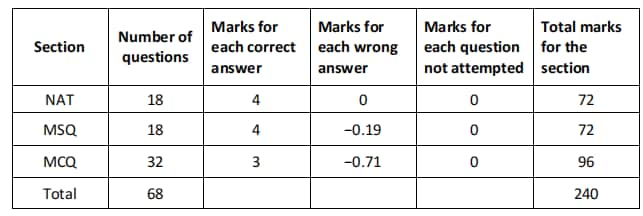
The marking scheme for UCEED 2025 is tabulated below. The marking scheme is divided into 3 sections of UCEED Part A.
Also Read:
Part A consisted of three sections whose detailed analyses are provided below.
1a | Difficulty Level | The difficulty level was Moderate to Easy |
1b | Ideal Time | 30-45 minutes |
1c | Good Attempt | 12-14 questions (No Negative Marking) |
1d | Focus Areas | Geometrical Concepts + Perspective Understanding + Visual and Logical Aptitude |
After analysis, we concluded that the questions were more concerned with the ability to approach problems strategically than they were with requiring a deep understanding of mathematics. Many of the issues might be solved even by someone with only a rudimentary background in mathematics by seeing the difficulties from multiple viewpoints.
The NAT part is the perfect balance of difficult and easy questions, and looking at the time limitation, one should always approach the questions that seem easy at first glance.
The focus was as per the understanding:
Scholars’ Round Deadline: 14th Nov’26 | Earn upto 50% merit Scholarship + 10% for top performers | EFMD Accredited | AACSB (USA) & AMDISA Member | Highest CTC 28 LPA
1200+ Recruiters for Placements | 30+ International Collaborations | 45+ Advanced Labs and Studios
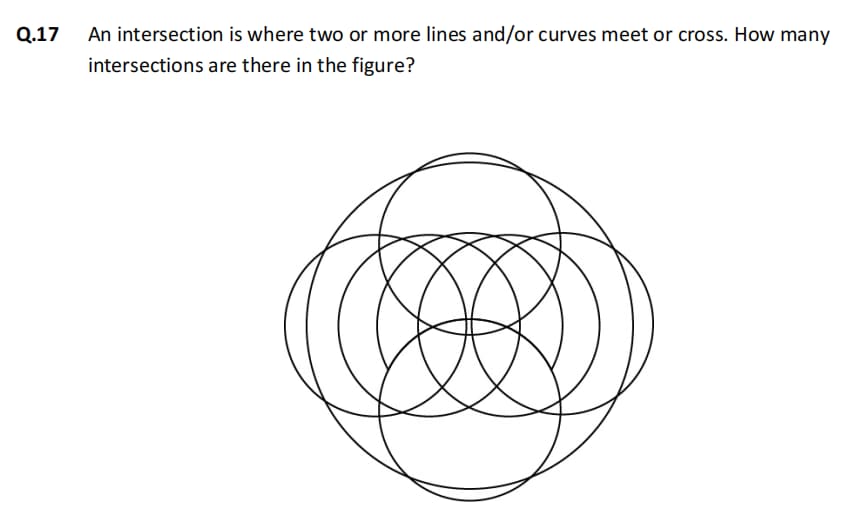
In some questions, more than direct knowledge of the subject matters; what matters more is the approach to solving the questions. Like in the example shared below, if one identifies the visual symmetry, it can save a lot of time by just counting intersections of half of the given figure. The other way an individual may count all the intersections, which is not advisable and also time-consuming.
Approach: Question 17, where the intersections are more like a mirror image if a virtual parting line is drawn vertically.
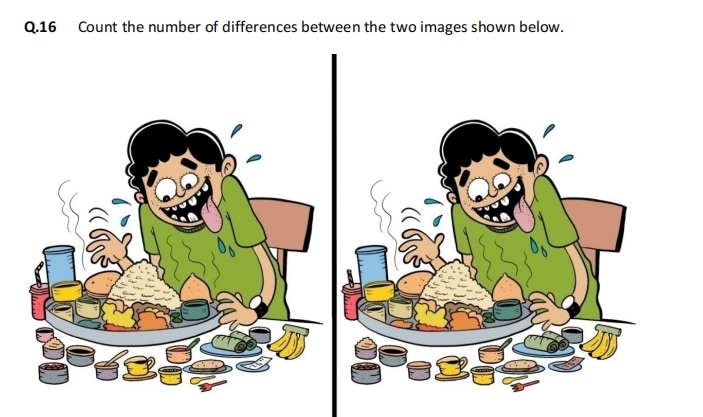
—Sometimes questions asked under the section Numerical Aptitude are very unpredictable and interesting, with a high chance of scoring. Below is an interesting example of counting the difference, which needs sheer observation skills.
Answer: 07 Difference marked
Significant Focus areas were as follows:
Verbal Reasoning (Statement-based Questions)
Light and Shadow + Direction Sense
Visualization Analogy/Pattern
Analysis: The questions asked in this section were usually easy-moderate, except for a few that were time-consuming. The questions asked were a perfect blend of practical application of two or more concepts, like Q-23/25.
2a | Difficulty Level | The difficulty level was Moderate |
2b | Ideal Time | 30-40 minutes |
2c | Good Attempt | 12-14 questions (04 marks for each question, but 0.19 negative marking for every wrong option chosen) |
2d | Focus Areas | Graphical Visualization and Spatial Ability + Verbal Reasoning(Statement & Interpretation) |
Verbal Reasoning (Statement-Based Questions, particularly) carries a weightage of more than 25% out of all the 18 questions asked, thus making it a good scoring area for the upcoming examinations in the future.
A Good Example of Q-28, for Statement-Based Questions (Verbal Reasoning)
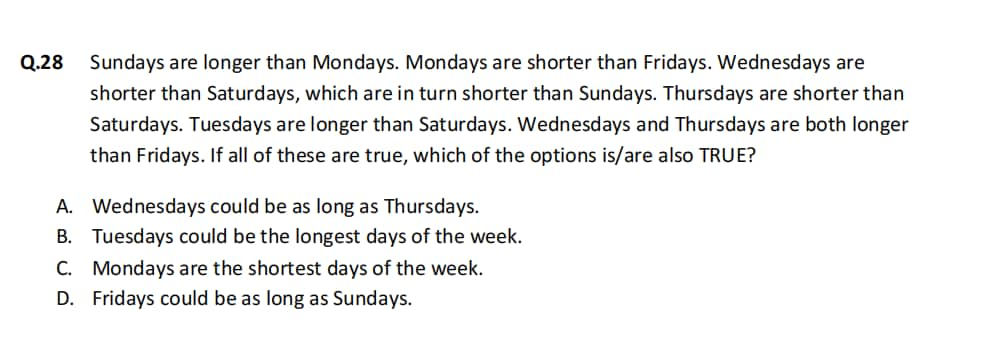
This section(MCQ) evaluates critical visual and spatial reasoning skills necessary for design, which is the goal of UCEED's questions, which include pattern recognition, font identification, and spatial transformations (such as water and mirror images). Questions involving pattern recognition test a person's capacity to recognize and anticipate sequences, which is essential for comprehending repetition and design progressions. Most questions required candidates to pay close attention to detail to ensure that they are able to see and recognize tiny distinctions.
Essential Topics for MCQ (Multiple Choice Questions)
Approach: Some questions are very easy to attempt and score via memories from everyday observations, unlike question 49, as shared below. Anyone with logic can tell the impact of load on human body posture, and further eliminating the odd one out would be the best approach to attempt such questions.
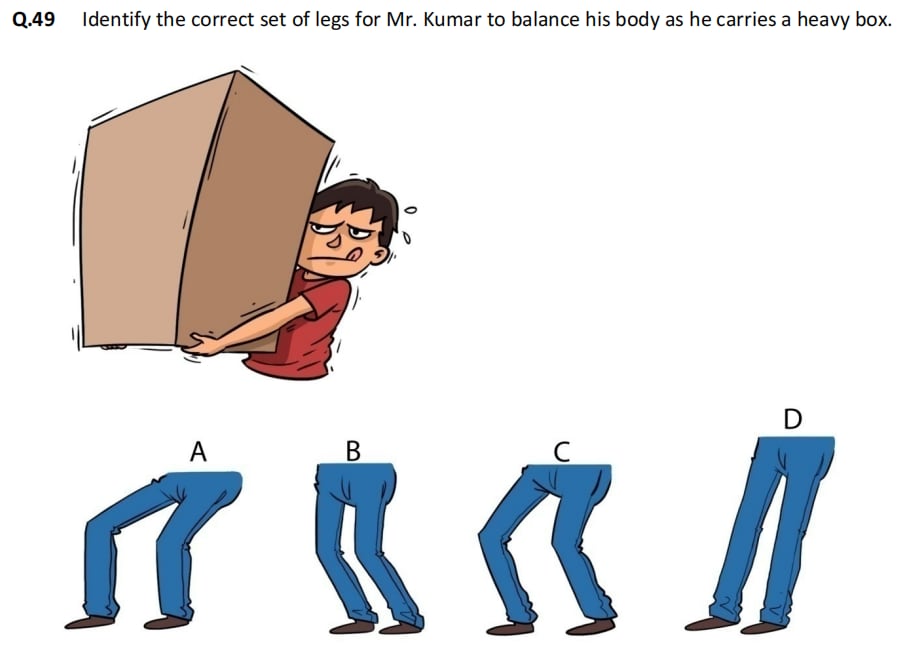
MCQ questions are usually easy, and most of them can be solved by logic and everyday life observations. The most crucial skill required is the fragmentation of the bigger solutions into mental chunks to simplify the visual interpretations. Once this skill is mastered, most questions in an MCQ become doable. Students can solve multiple UCEED mock tests and use appropriate UCEED study material to get more help. Students can look at the UCEED 2020 question paper PDF for more such examples.
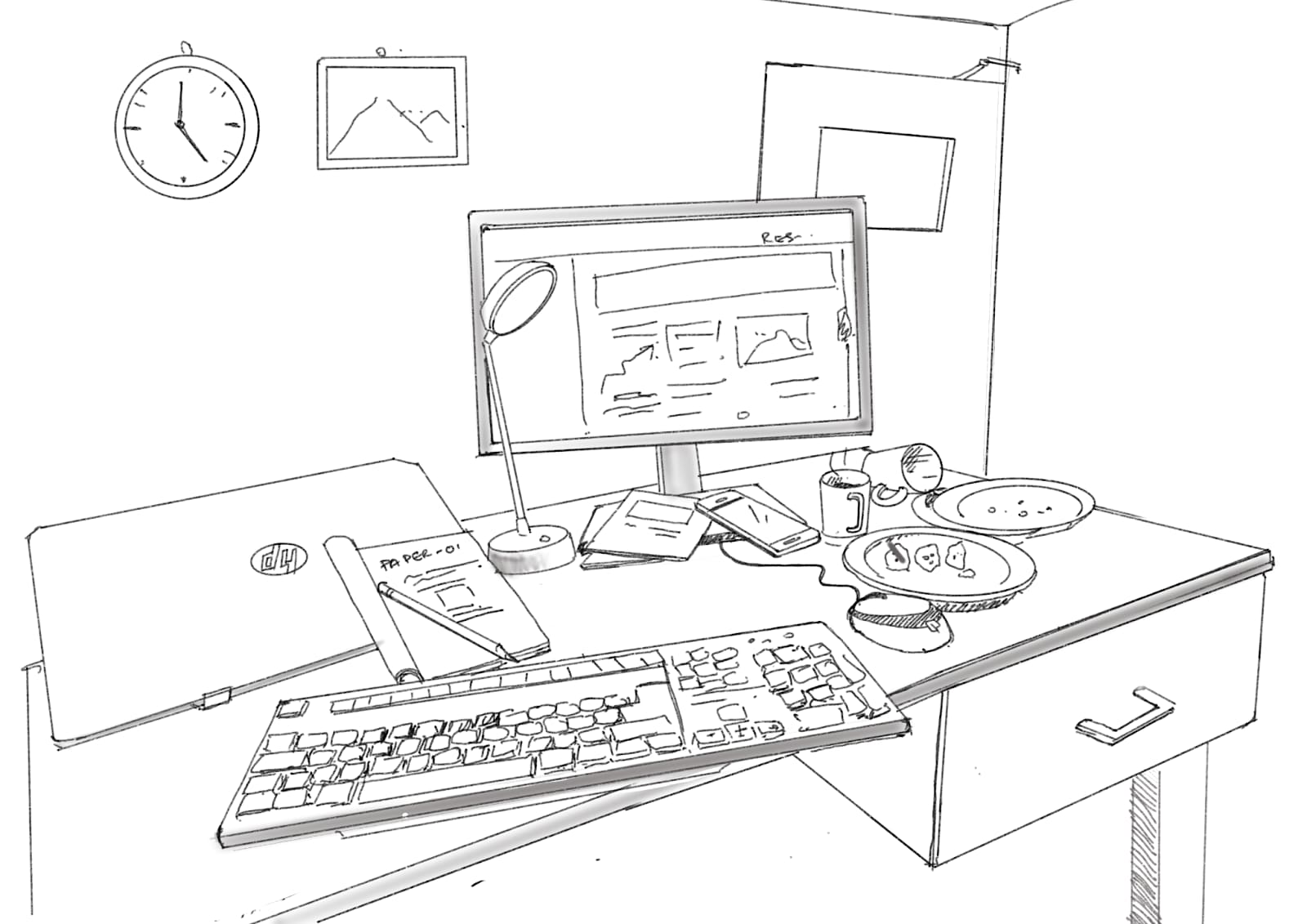
Part B, Drawing questions, is meticulously crafted to test an aspirant to reflect practically within the given time frame. Let’s understand the requirements for Part B. Understanding of Scale, Proportions and Perspective View: As given, the table is a mess, so there would be stuff lying of different shapes and sizes and at a distance from each other, needing an understanding of perspective.
Compositional Drawing: The question needs a great understanding of composition, as through a sketch, the aspirant has to convey the shady tone of the room with the table in focus, and particularly the objects like a cup of tea(half), a plate of pakodas, etc.
Overall, the UCEED question paper 2020 was moderate but time-consuming. Students preparing for this exam can look into strategies like How to prepare for UCEED in a year to get a better hang of preparation and ace the exam.
Also Check:

On Question asked by student community
Yes, you can complete the UCEED syllabus in three months and aim for a decent score with consistent preparation. Study the syllabus, practise drawing and logical reasoning daily, and solve previous years' question papers and mock tests.
Useful Careers360 links:
https://design.careers360.com/articles/uceed-syllabus-2027
You can download the UCEED 2027 GK Questions Preparation Tips PDF from Careers360 here:
https://design.careers360.com/download/ebooks/uceed-gk-questions-preparation-tips
Hello Student,
To start your NID DAT and UCEED preparation, begin with the syllabus, exam pattern, and previous years' question papers. You can also refer to the Careers360 preparation resources and sample papers for regular practice using the links provided below.
Hi Student,
You can practise previous-year UCEED, NIFT and NID questions and check the correct answers or solutions after attempting them. For UCEED, Careers360 provides previous-year papers with answer keys, while NIFT papers are available with solutions. NID previous-year papers with solutions are also available for practice.
You can start
Hello Dear Student,
With UCEED AIR 130 (Open category) and currently allotted IIITDM Jabalpur under the FLOAT option, your chances after Rounds 4 and 5 depend on how many higher-ranked candidates withdraw or move to their preferred institutes.
Based on recent Round 5 Open-category closing ranks:

Leading Design College | 95% Placement Record | Merit-cum-Means Scholarships for Deserving Students
Ranked #45 amongst Universities in India by NIRF | Get Upto 100% Scholarships | Spot Admissions via CUET
Scholars’ Round Deadline: 14th Nov’26 | Earn upto 50% merit Scholarship + 10% for top performers | EFMD Accredited | AACSB (USA) & AMDISA Member | Highest CTC 28 LPA
1200+ Recruiters for Placements | 30+ International Collaborations | 45+ Advanced Labs and Studios
Faculty from A+ Design schools of India and Abroad | 100% Placement Assistance
1200+ Recruiters for Placements | 30+ International Collaborations | 45+ Advanced Labs and Studios