
Search Colleges, Exams, Schools & more


Login
Pursue B.Des Interior Design Course at Chandigarh University Uttar Pradesh in 2026: Design Meets the Future
A well-designed room does something quiet but powerful - it changes how people feel the moment they walk in. Somebody trained to make that happen, again and again, across homes, offices, and hotels, will always have work waiting. That is the promise behind the best Bachelor of Design in Interior Design programme, and Chandigarh University, Uttar Pradesh (CU-UP) has built its version of this programme around where the profession is actually heading, not where it used to sit.
This Story also Contains
- About the B.Des Interior Design Programme at CU-UP
- B.Des Interior Design at CU-UP: Key Highlights
- Why is CU-UP Built Differently?
- AI-Driven Tools Students Train On
- Career Pathways After the Programme
- Why is Interior Design a Smart Career Choice Right Now?
- Eligibility & Admission Process
- Conclusion
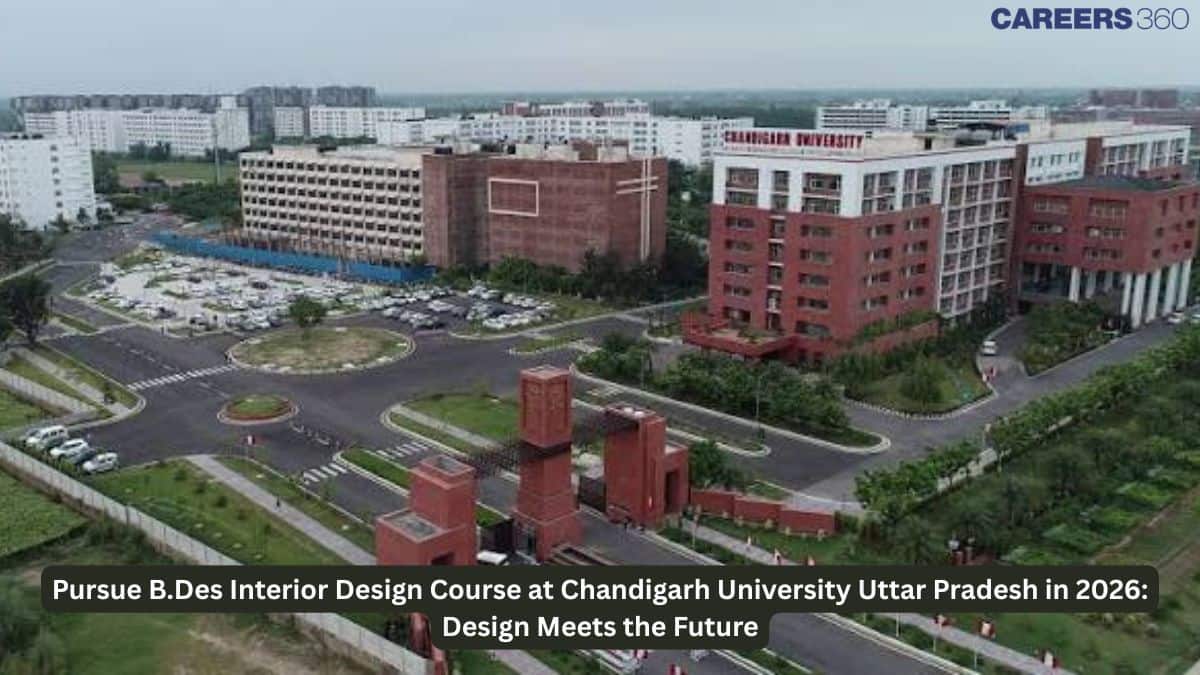
Located on the Lucknow-Kanpur Highway in Unnao, CU-UP is India's first AI-Augmented Multidisciplinary University, and its B.Des Interior Design programme is one of the clearest expressions of that identity. Students here are not just learning to sketch a floor plan. They are learning to think in AI-assisted visuals, sensory experience, and immersive simulation, skills that are quickly becoming the baseline for serious design careers rather than a bonus.
Also See: Chandigarh University Admissions
About the B.Des Interior Design Programme at CU-UP
The programme blends multisensory thinking with intelligent visualisation, training students to design spaces that respond to how people actually move, feel, and behave within them. Learning happens inside state-of-the-art studios and labs equipped with the latest AI technologies, giving students the tools to design immersive, futuristic spaces rather than just draw them on paper. Strong exposure to leading companies gives students opportunities to do internships, workshops & capstone projects in the programme, which introduce them to the traditional practice of interior design and the new trends that are redefining the industry.
B.Des Interior Design at CU-UP: Key Highlights
| Parameter | Details |
|---|---|
Programme Duration | 4 Years (Undergraduate) |
University Identity | India's First AI-Augmented Multidisciplinary University |
AI Integration in Curriculum | 20% - digital modelling, AI visualisation tools, contemporary design processes |
Experiential Learning | 25-30% - internships, workshops, capstone projects, field visits, client-led studio work |
Location | Lucknow-Kanpur Highway (NH-27), Unnao, Uttar Pradesh |
Admission Route | CUCET - Chandigarh University Common Entrance Test |
Scholarship | Merit-based scholarship up to 100% tuition waiver on CUCET score |
Why is CU-UP Built Differently?
AI-Augmented Foundations:
Before students design a single space, they build their foundations through AI-powered concept prompts, visualisation tools, and material fundamentals. Spatial psychology and sensory perception are treated as core subjects here, not electives tucked away at the end of the course.
Applied Design Frameworks:
Students get direct, practical exposure to both residential and commercial interiors, supported by dedicated TextFX sensory studios. The focus on spatial psychology helps them design multisensory spaces and build strong visual narratives, rather than simply arranging furniture on a floor plan.
Spatial Design & Simulation Environment:
This is where the programme pulls ahead. Students work across hospitality design, neurodiversity-friendly spaces, and biophilic interiors, using VR and AR simulations with sensory mapping and thematic concept development. It is design education that treats the future of the industry as the present curriculum, not a someday upgrade.
Industry-Integrated Learning:
Internships paired with research work give students the chance to build final visualisations, film-based walkthroughs, and exhibition-ready portfolios - the kind of body of work that speaks for itself in front of a recruiter or a client.
AI-Driven Tools Students Train On
| Tool | What It's Used For? |
|---|---|
Midjourney | Fast AI-generated design boards to test different artistic styles, moods, and lighting choices in seconds |
DALL-E | Turning simple text instructions into interior layouts, material specifications, and design elements |
Leonardo AI | Semi-3D rendering that brings spaces to life with depth, realism, and presentation-ready polish |
Google TextFX | Sensory language experimentation that strengthens prompt engineering and enriches visual storytelling |
VR Spatial Walkthroughs | Virtual tours of a complete space, letting students study movement, scale, and sightlines before construction starts |
Career Pathways After the Programme
Interior Designer (Residential / Commercial).
Space Planner.
Furniture & Fixture Designer.
3D Visualisation Artist.
Interior Design Technologist.
BIM / Digital Modelling Specialist.
AR/VR Spatial Experience Designer.
Read More: Chandigarh University Courses
Why is Interior Design a Smart Career Choice Right Now?
The global interior design market stood at roughly USD 137,930.0 million in 2024 and is projected to reach USD 175,741.3 million by 2030, growing at a compound annual rate of 4.3 percent from 2025 to 2030. That kind of steady, sustained growth points to a genuinely wide field of opportunity for anyone entering the profession over the next few years.
What makes this moment different is how much of the workflow is shifting toward AI-assisted tools. Concepts that once took days to render can now be visualised in minutes, freeing designers to spend their energy on the ideas that actually need a human eye - reading a client's brief, understanding how people will really use a space, and translating that into something functional and beautiful. Students who train on these tools as part of their core education, rather than picking them up later out of necessity, step into the workforce with a real head start. CU-UP has built its Interior Design programme around exactly that shift.
Eligibility & Admission Process
Educational Eligibility: Candidates need to have completed 10+2 or an equivalent qualification from a recognised board, with the required aggregate percentage.
Admission Route: Admissions are done through CUCET, the Chandigarh University Common Entrance Test, followed by the standard application process.
Scholarship: Merit-based scholarships up to 100% through CUCET can bring tuition fees down significantly.
Also Read: Chandigarh University Placements
Conclusion
Every well-designed space starts as an idea on a blank page, and the designer who can turn that idea into somewhere people genuinely want to live, work, or gather will always be in demand. Chandigarh University, Uttar Pradesh has built its B.Des Interior Design programme around exactly that kind of designer - one who is as comfortable with a stylus and a VR headset as with a mood board and a client brief.
With AI woven into the curriculum, sensory studios built for real spatial thinking, and a steady stream of internships and industry projects, CU-UP is training students for the profession as it stands today, not the version that is already fading out.
Apply now at www.culko.in and register for CUCET. The future of design is being built right now, and it starts here.
Disclaimer: This article has been published as a part of marketing collaboration between Careers360 and Chandigarh University.
Frequently Asked Questions (FAQs)
Q: What is the B.Des Interior Design programme and what does it offer?
A:
B.Des Interior Design at Chandigarh University, Uttar Pradesh is a four-year undergraduate programme & through this programme, students build core design skills across functional, aesthetic, and user-centred interior spaces. Within the duration of four years, the course develops creativity, spatial planning ability, and technical design knowledge in students for a professional career in interior design.
Q: What are the eligibility criteria for admission to B.Des Interior Design at CU-UP?
A:
Candidates need to have passed 10+2 or an equivalent qualification from a recognised board, meeting the minimum aggregate requirement set by the university.
Q: What scholarships are available for students applying to B.Des Interior Design at CU-UP?
A:
Merit-based scholarships tied to CUCET scores are available, with high-performing candidates eligible for a tuition waiver of up to 100%.
Q: Is there any internship provided in B.Des Interior Design?
A:
Yes, CU-UP has a variety of corporate partnerships that provide students with internships and also capstone projects and workshops to build traditional and emerging interior design skills.
Q: Which university is best for B.Des Interior Design in Uttar Pradesh?
A:
What sets Chandigarh University, Uttar Pradesh, apart is the AI-integrated curriculum, purpose-built design studios, and the structured career paths built into the programme itself.
Q: Does Chandigarh University Uttar Pradesh provide placement assistance to B.Des Interior Design students?
A:
“Yes, absolutely. The university integrates industry exposure with internships and corporate partnerships within the programme itself, so students can transition from building a portfolio to getting placed.
Q: What are the career opportunities after B.Des Interior Design in CU-UP?
A:
Graduates can work in residential, commercial, and hospitality design as Interior Designer, Space Planner, Furniture and Fixture Designer, 3D Visualisation Artist, BIM/Digital Modelling Specialist, and AR/VR Spatial Experience Designer.
Q: What is the average salary after B.Des Interior Design?
A:
Salaries vary with portfolio strength, specialisation, and the sector a graduate enters, but demand for designers skilled in AI-assisted visualisation continues to push compensation upward across the profession.
Q: What are the companies that recruit B.Des. Interior Design students of CU-UP?
A:
CU-UP has created a comprehensive network of companies ranging from interior design studios and architecture firms to hospitality brands, providing graduates access to a wide variety of potential employers in residential, commercial and hospitality interior design.
Q: What are the Top Paying Jobs after B.Des Interior Design?
A:
The highest paid roles are those that combine design skill with technical fluency: BIM Specialists, AR/VR Spatial Designers and senior Interior Designers working on commercial or hospitality projects.
Articles
Upcoming Design Exams

Certifications By Top Providers
Explore Top Universities Across Globe
List of Related colleges
Questions related to Chandigarh University
On Question asked by student community
Have a question related to Chandigarh University ?
Hello Student
If you are comparing them for B.Tech , BMSIT Bangalore is a strong option, especially for engineering-focused students. It has a 2025 NIRF Engineering rank in the 201–300 band and a 2025 median UG salary of Rs.5.5 LPA. Chandigarh University has a broader range of courses, a higher
Hello Dear Student,
Could you provide more information so that i could help you further!
Hello Dear Student,
With 119 marks in HPCET and 73% in Class 12 , you meet the eligibility requirements for B.Tech admission in Himachal Pradesh.
Your HPCET score is competitive and should give you a reasonable chance of admission to participating engineering colleges through the counselling process. The exact college
Hello Dear Student,
Please tell me is chandigarh university under pmsss, I want to take admission. careers 360Yes, Chandigarh University is a recognized institution that actively participates in and accepts admissions under the Prime Minister's Special Scholarship Scheme (PMSSS) for eligible students from Jammu & Kashmir and Ladakh.
You can
Hello Dear Student,
Yes, Chandigarh University is a recognized institution that participates in admissions for students under scholarship schemes and is a popular choice among PMSSS applicants from Jammu & Kashmir and Ladakh. PMSSS is administered by AICTE for eligible students from these regions pursuing higher education outside their home

Applications for Admissions are open.
Ranked #45 amongst Universities in India by NIRF | Get Upto 100% Scholarships | Spot Admissions via CUET
Woxsen University, Hyderabad
ApplyScholars’ Round Deadline: 14th Nov’26 | Earn upto 50% merit Scholarship + 10% for top performers | EFMD Accredited | AACSB (USA) & AMDISA Member | Highest CTC 28 LPA
Pearl Academy, South Delhi Campus, New Delhi
ApplyGet up to 100% scholarship on B.Des. & BBA admissions through your CUET-UG score | No. 1 Design & Fashion Institute by ASSOCHAM, India Today, Outlook and The Week rankings
Unitedworld Institute of Design, Ahmedabad
Apply1200+ Recruiters for Placements | 30+ International Collaborations | 45+ Advanced Labs and Studios
Indian Institute of Art and Design, New Delhi
ApplyLeading Design College | 95% Placement Record | Merit-cum-Means Scholarships for Deserving Students
ITM Institute of Design and Media, Andheri Campus, Mumbai
ApplyFaculty from A+ Design schools of India and Abroad | 100% Placement Assistance