School of Design, UPES, Dehradun
Ranked #45 amongst Universities in India by NIRF | Get Upto 100% Scholarships | Spot Admissions via CUET


It has been a continuous and frequently asked question among the students preparing for the NID exam that how to save the time in sketching in the NID 2027 Exam. As it was seen in the NID 2026 question paper, it did not have any Part-A section and questions were only based on creative ability. All the questions were based on drawing and design thinking aptitude making it an important section for students to prepare. Therefore, experts have curated 6 time saving sketching techniques for NID’s 3 hour exam to help students in their NID 2027 preparation.
.jpg)
According to the NID Exam Syllabus and NID DAT Exam Pattern, NID examines students for the following:
U - User ( whom the problem is focussed)
P - Problem ( what are you solving for)
S - Solution (what and how you are approaching the challenge)
Imagine the situation where you are resolving the human figures in the middle of paper, the page looks attractive but something seems un-proportional. Many good design aspirants lose time because they try to finish the sketch like an artwork.
Students are also advised to check:
Ranked #45 amongst Universities in India by NIRF | Get Upto 100% Scholarships | Spot Admissions via CUET
Scholars’ Round Deadline: 14th Nov’26 | Earn upto 50% merit Scholarship + 10% for top performers | EFMD Accredited | AACSB (USA) & AMDISA Member | Highest CTC 28 LPA
The current NID B.Des admissions handbook describes the DAT prelims as a pen-pencil test that may contain text and visuals, thus with the evolving patterns it becomes critical to follow the instructions issued for the exam. In this article we would share the techniques to immediately add to the productivity of the aspirant :
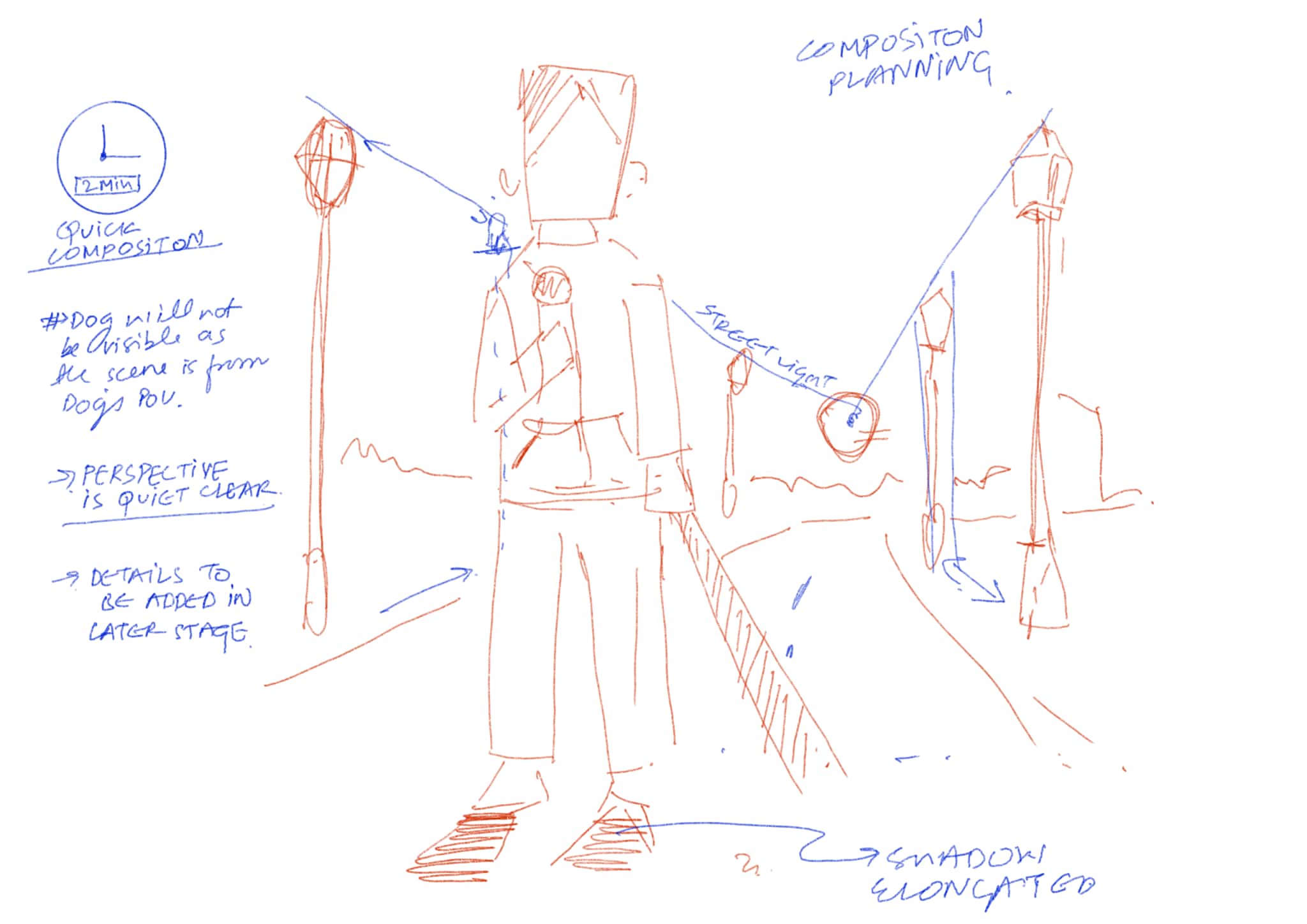
This is the first practice an aspirant should follow, where one should spend first 30 to 60 seconds sketching the rough form of the solution, in the form of thumbnail sketches for composition, placements of elements and product scale, planning the negative space etc. before jumping to the main drawing.
E.g. If the question asks you for the “bus-Stand for elderly passengers”, dedicate quick three thumbnails with focus on waiting on waiting area, user interactions, boarding and unboarding bus etc. in your solution.
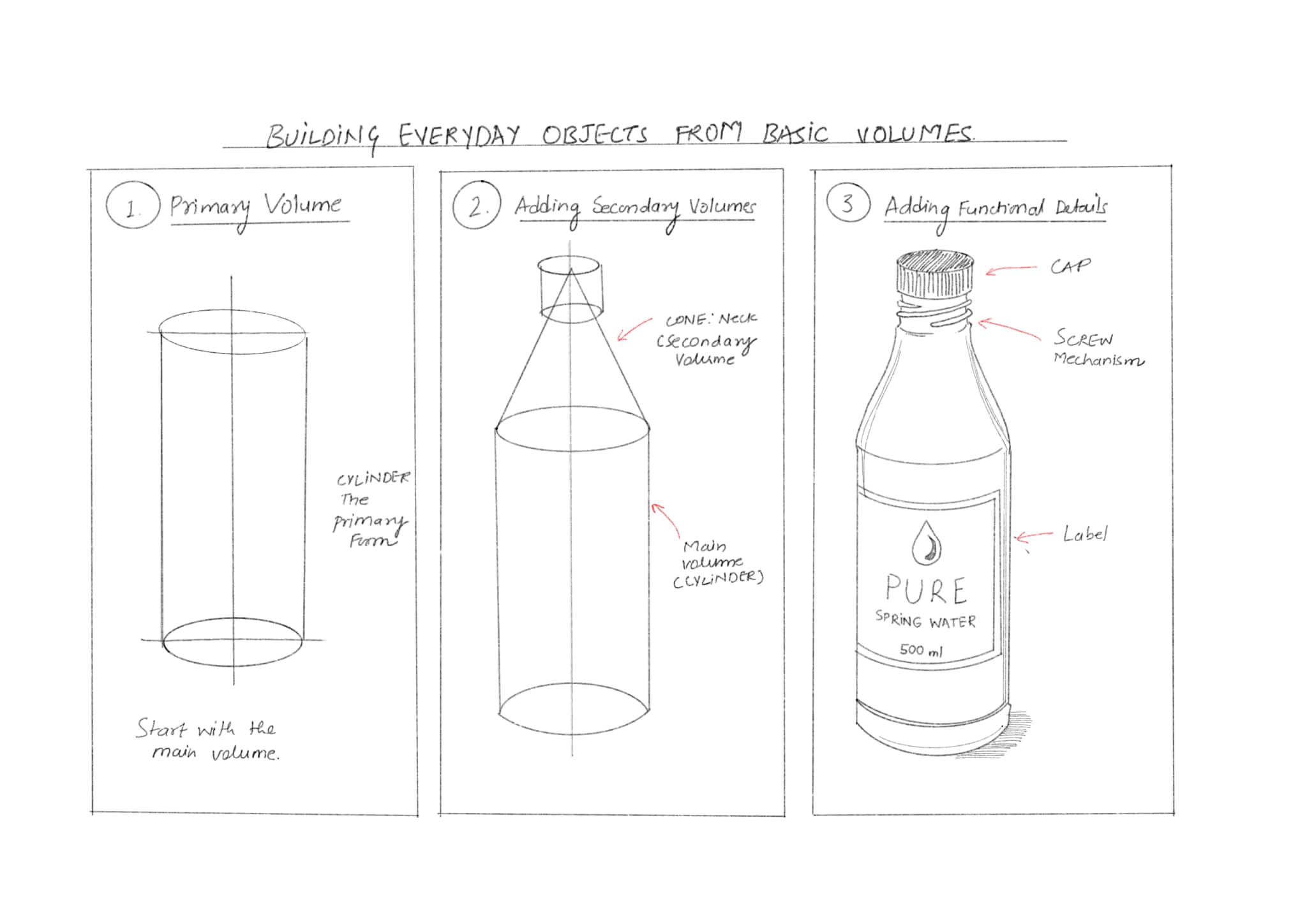
Most everyday objects are built of the combination of the geometric forms like cubes, cylinders, cones, spheres and flat planes etc. For example if we look at a bottle it is a combination of a cylinder and cone primarily as explained below though sketch.
Use a three step sequence, as follows:
Draw the Primary Volume, e,g, the primary volume in the bottle is cylinder.
Add Secondary volumes to add to details : Like a bottle may have the neck in the cone form as explained below.
Lastly adding the Functional Details : Like for a bottle the functional details would be the label, cap and the screw mechanism on the top to tighten the cap.
Related Articles:
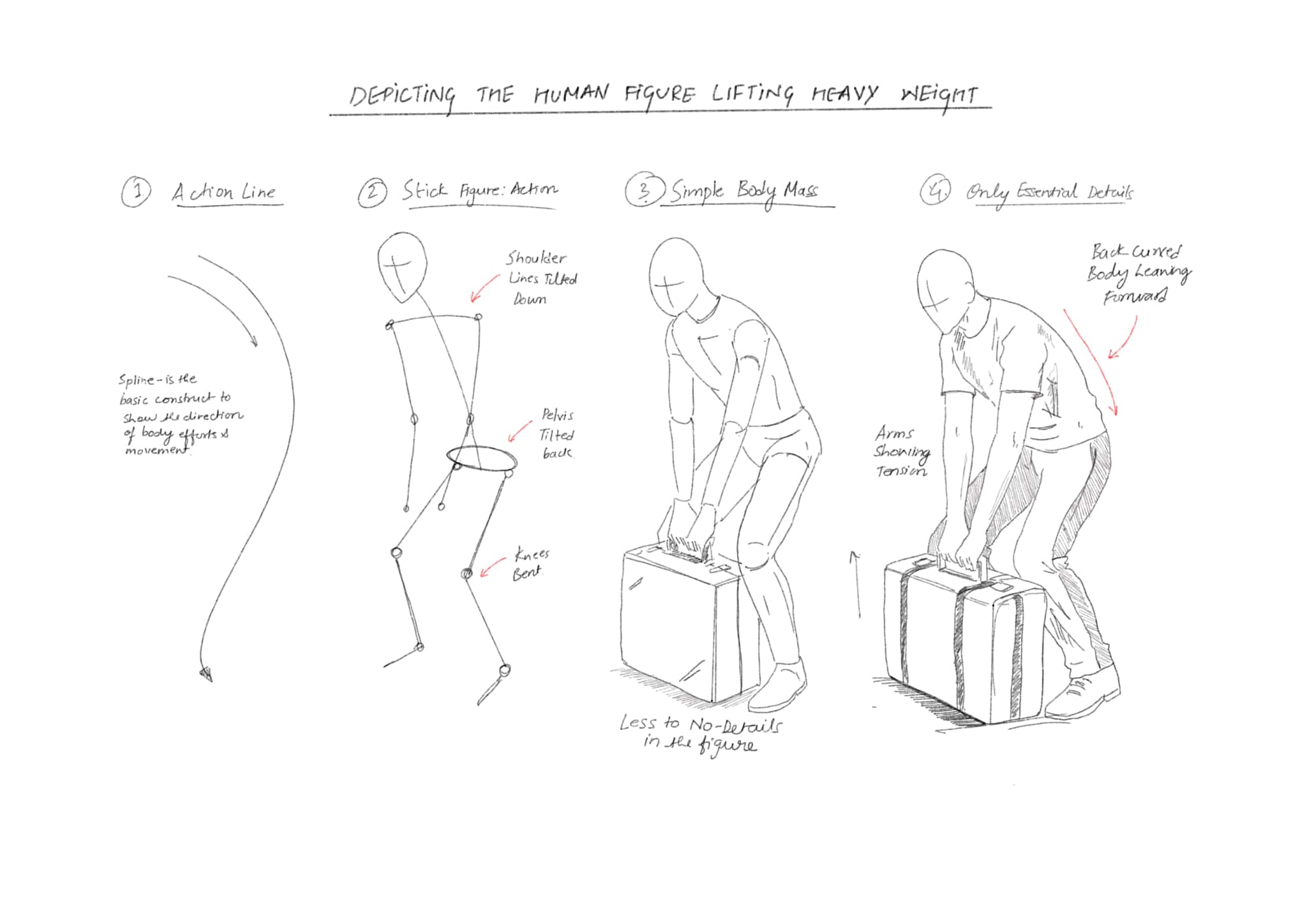
It is a common observation that students devote a lot of time making the details like facial features, hair and figure, where only proportional drawing of the human is sufficient to show the interaction with the product with the action lines assisting the movement details.
E.g. Imagine a person holding the “heavy suitcase on a railway platform”, the action lines should depict the curved spline, lowered shoulders and bent knees to explain the visual weight of the load and adding to it the little expressions.
Students are advised to go through How to Score Well in NID DAT Drawing Section and How to Master the Art of Drawing and Sketching Skills for better understanding and preparation plan.
For the sketches that require more focus on details, you should have the focus on line hierarchy, with visual weights, where the important parts to be the darkest and medium line for the user are the essential construction and keeping the background light, to immediately pop the proposed solution.
For Example : The classroom storage solution, the strongest line should be the outline, the child opening the storage in medium tone and other details like desks and wall may go the lightest in overall composition.
Related Articles:
Let’s first understand the two-pass method.
Pass 01 : Finish the Complete Communication (i.e. establishing the composition, draw the important elements, and solution highlights in the first pass)
Pass 02 : Work on improving the elements supporting the main idea.
(i.e work on the annotation, outlines, detail and apply the limited shading etc.)
NID DAT Previous Year Question Papers : Students can start by looking at previous year questions to understand the type of questions that are generally asked in NID DAT Exam. Students preparing for the NID DAT exam are advised to solve NID sample papers and NID mock tests as it would develop the understanding of the language of the paper and insights on what are important areas of focus and Most Asked Questions in NID prelims
Following are the mistakes an aspirant makes in the exam hall that cost more than marks the valuable time, that can decide your merit. Below we have highlighted some of them that can cost an individual:
Repeatedly erasing the wrong sketches cost you time as well as the tidiness, a crucial element in the exams.
The second mistake aspirants do is hiding the unclear ideas with unnecessary rendering that is not required in the exams.
Focussing too much on the details. Like backgrounds, colouring and hatching even it is not the need of the question paper.
Your speed only does not matter in the NID exam for scoring well, it is a combination of the strategy, planning and fast visual decisions an aspirant makes in the examination hall. Practising the techniques as shared above like thumbnail sketching, constructing the forms, gesture posture lines etc. are the real skills in the examination hall.
A Strong Idea + Planned Composition + Selective Detailing = Successful Sketching Strategy in NID
Students should also check:

On Question asked by student community
Dear Student,
For NID DAT exam preparation, you can follow the preparation tips provided by Careers360. The article covers important aspects such as understanding the exam pattern and syllabus, choosing the right study material, practising previous-year papers, and taking mock tests.
Use these strategies
Hello Student,
To start your NID DAT and UCEED preparation, begin with the syllabus, exam pattern, and previous years' question papers. You can also refer to the Careers360 preparation resources and sample papers for regular practice using the links provided below.
No, the NID DAT Prelims paper is not exactly the same for B.Des and M.Des aspirants.
You can check these resources for more clarity:
https://design.careers360.com/articles/nid-dat-sample-papers
https://design.careers360.com/articles/nid-mdes-previous-year-question-papers-with-solution
Hello Dear Student,
Could you provide more information so that i could help you further
No specific stream is required in Class 11 for BDes admissions. You can join B.Des (Bachelor of Design) with any stream in Class 11th (Science, Commerce, or Arts/Humanities). Top design institutes like NID ( NID DAT scores) and NIFT ( NIFT Entrance Exam ), as well as IITs (via UCEED),

Ranked #45 amongst Universities in India by NIRF | Get Upto 100% Scholarships | Spot Admissions via CUET
Scholars’ Round Deadline: 14th Nov’26 | Earn upto 50% merit Scholarship + 10% for top performers | EFMD Accredited | AACSB (USA) & AMDISA Member | Highest CTC 28 LPA
1200+ Recruiters for Placements | 30+ International Collaborations | 45+ Advanced Labs and Studios
Faculty from A+ Design schools of India and Abroad | 100% Placement Assistance
1200+ Recruiters for Placements | 30+ International Collaborations | 45+ Advanced Labs and Studios
Get up to 100% scholarship on B.Des. & BBA admissions through your CUET-UG score | No. 1 Design & Fashion Institute by ASSOCHAM, India Today, Outlook and The Week rankings