
Search Colleges, Exams, Schools & more


Login
Creative Problem-Solving Techniques for UCEED Aspirants
Creative problem-solving is more than a skill set mixed with a technique for generating ideas/solutions for a given situation. It is a crucial skill set for every aspirant striving to perform in the UCEED 2027 exam. In the Design Aptitude examination, a situation is provided where an aspirant is expected to generate solutions practically close to life and fulfil the need of the question.
This article introduces a detailed study guide for the most crucial design thinking techniques for your UCEED 2027 exam for both Part-A and Part-B.
Understanding of Question Themes: UCEED 2027 Exam
Creative problem-solving skills in the UCEED are not only asked in Part-B (Drawing Aptitude) but also in Part-A (Design Aptitude, or Logic Question), according to the UCEED 2027 exam pattern and UCEED 2027 syllabus. Officially, the questions are asked from 07 broad areas as follows for Part-A:
Spatial Reasoning and Visualisation
Practical and Scientific Knowledge
Observation and Design Sensitivity
Environment and Society
Analytical and Logical Reasoning
Creativity through analogies
Language + Metaphors + Signs and Symbols
Note : A question asked is mostly a combination of topics like geometry or observation or logical reasoning etc.
UCEED 2027 Problem Solving Techniques: Part-A (Design Aptitude)
This topic will be covering the most frequently asked questions with the techniques for "problem-solving" for the particular type of questions as:
Visual Search and Selective Attention
Multiple questions asked in the past have placed similar objects in a crowded-composition where one has to count, classify or identify them distinctively unlike one below.
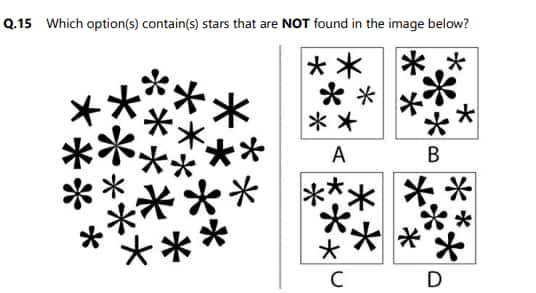
Problem Solving Approach : Visual Distinguishing
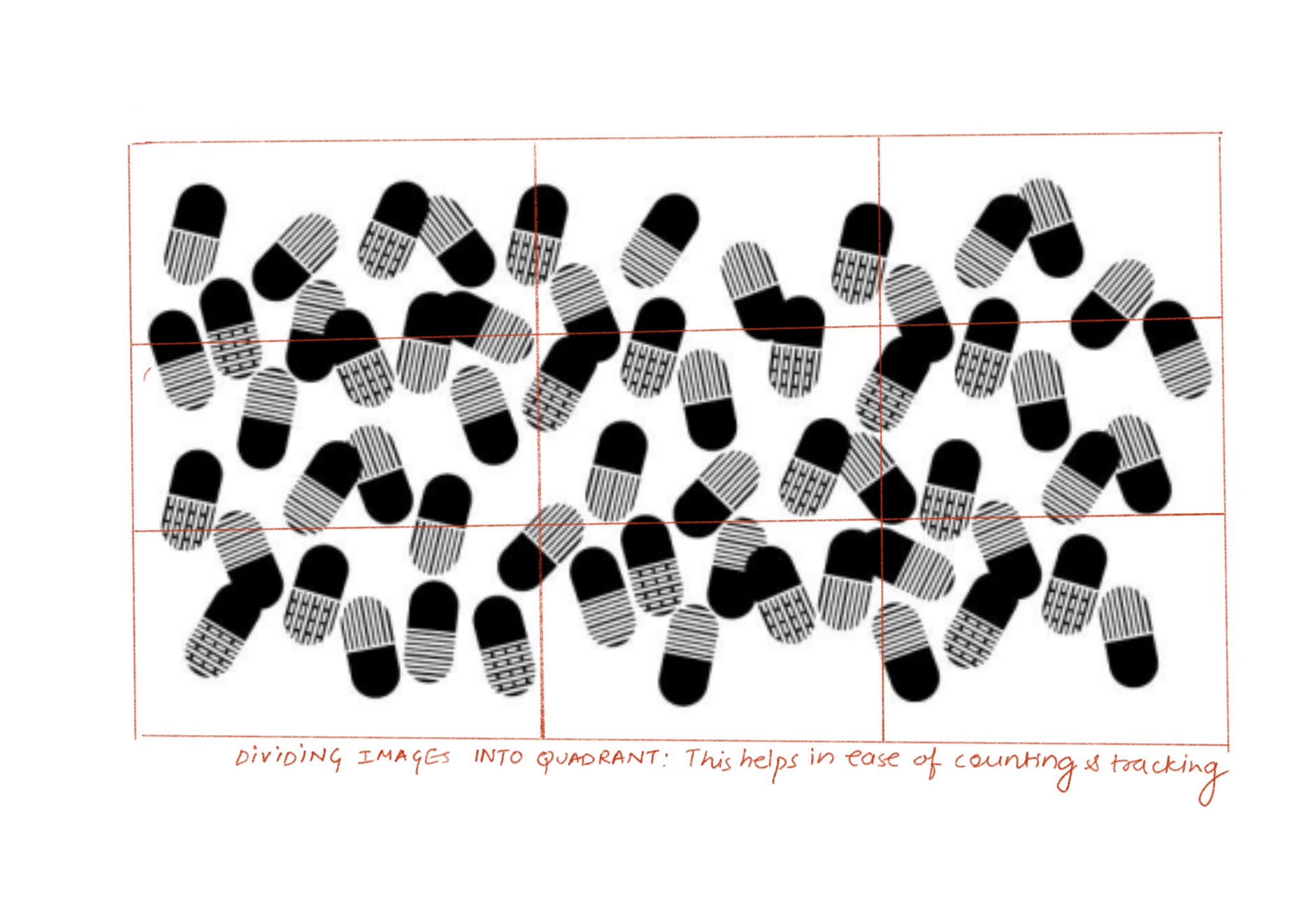
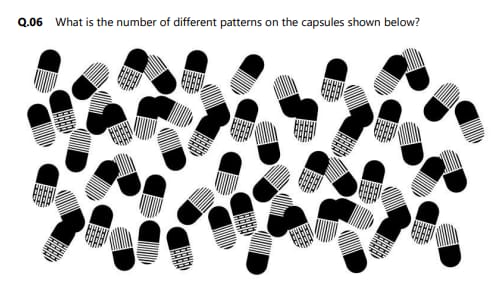 Search for the visual distinct features, look for the asked attribute or the combination of the features. Scan the image from “left to Right” into quadrants, mark the counted objects on a rough sheet.
Also Read:
UCEED 2027 High Weightage Topics & Questions
Download the ebook to practice most repeated UCEED questions, important topics, PYQs, visual reasoning & design aptitude trends for effective exam prep.
Download EBookSCAMPER Method - Tips and Tricks to Solve UCEED 2027 Questions
The SCAMPER (Substitute, Combine, Adapt, Modify, Put to Other Use, Eliminate and Reverse) technique is very useful, triggering the “Alternative Thinking” concept in the Creative Thinking Approach.
Let’s Try to understand this method with an example of a chair that could be understood as
(S) Substitute : Could you replace the wood with recycled plastic?
(C) Combine : Could you merge the chair with storage space underneath?
(A) Adapt : How might you adapt the chair for children?
(M) Modify : Can you modify the shape to make it more ergonomic?
(P) Put it to another use : Could the chair be folded into a walking stick?
(E) Eliminate : What if you eliminate one leg and create a stool?
(R) Reverse : Could the seating be done in reverse, creating a new sitting posture?
Similarly, the SCAMPER Tool can be applied to any of the Given situations, and asking the relevant questions as mentioned above, can motivate you to generate unique solutions for the challenges provided in DAT-Examinations. Students are advised by experts to focus more on self study and how to prepare for UCEED Without Coaching with keeping coaching and other preparation aids for guidance and doubts.
BioMimicry : Inspiration from Nature
We have evolved in 3.8 Billion years to be one of the most efficient species, where nature has been a master designer solving the most complex challenges of survival. Designers take inspiration from the “Master Designer: Nature” and that can be your next Big idea.
Example Design Brief :
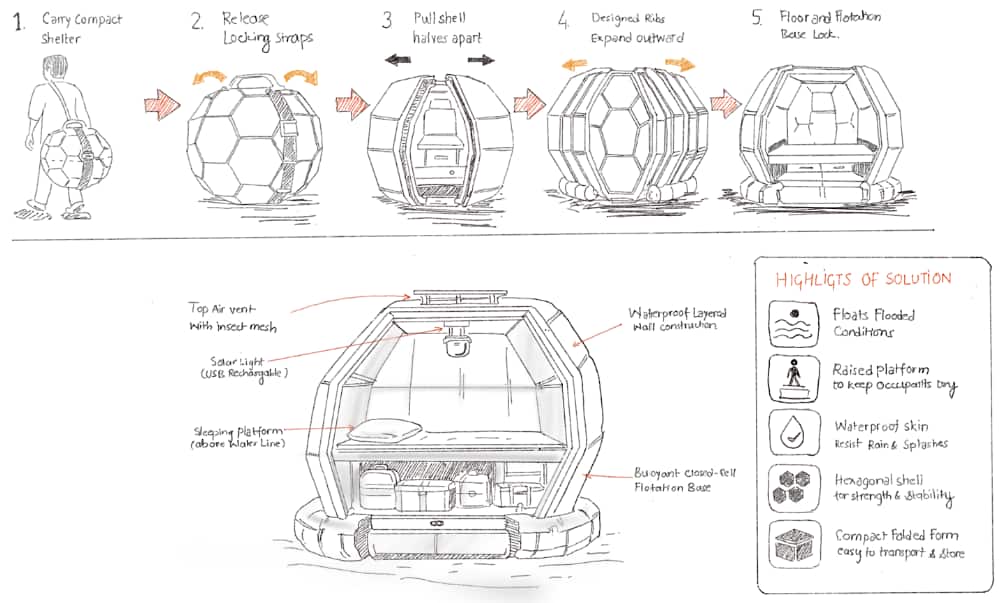
Design a Compact, foldable Solution for the “Flood victims”.
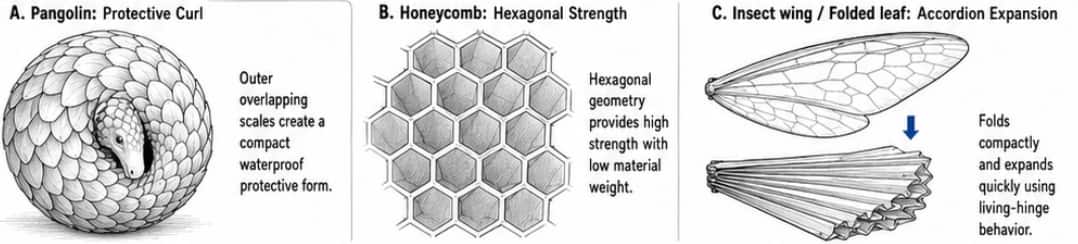
Bimomimcry : look for the organic shapes, solution like “Origami-like Folding of a beech Leaf” or , Self-Expanding structure like an insect's hindwings that may be your inspiration, inspired from nature.
The above design is inspired from nature as:
A. Pangolion : Protective Curve(hexagonal Shape)
B. HoneyComb : Hexagonal Shape (bee-hive)
C. Insect Wing : Folding Structure
Related Articles:
Lotus Bloom Technique : Structured Divergence
This technique developed by Japanese Thinker “ Yasua Matsumura”, is a framework for organised brainstorming, checking the ideas not going off track while ensuring the deep exploration. Let’s try to understand the same with example:
Bloom Technique : You begin with “Core-Problem” to be solved in the middle of a 3X3 grid, where you start filling the surrounding eight boxes with related concepts. Then you are tasked to take each concept and place them in the centre of a new 3X3 grid, generating 08 new ideas.
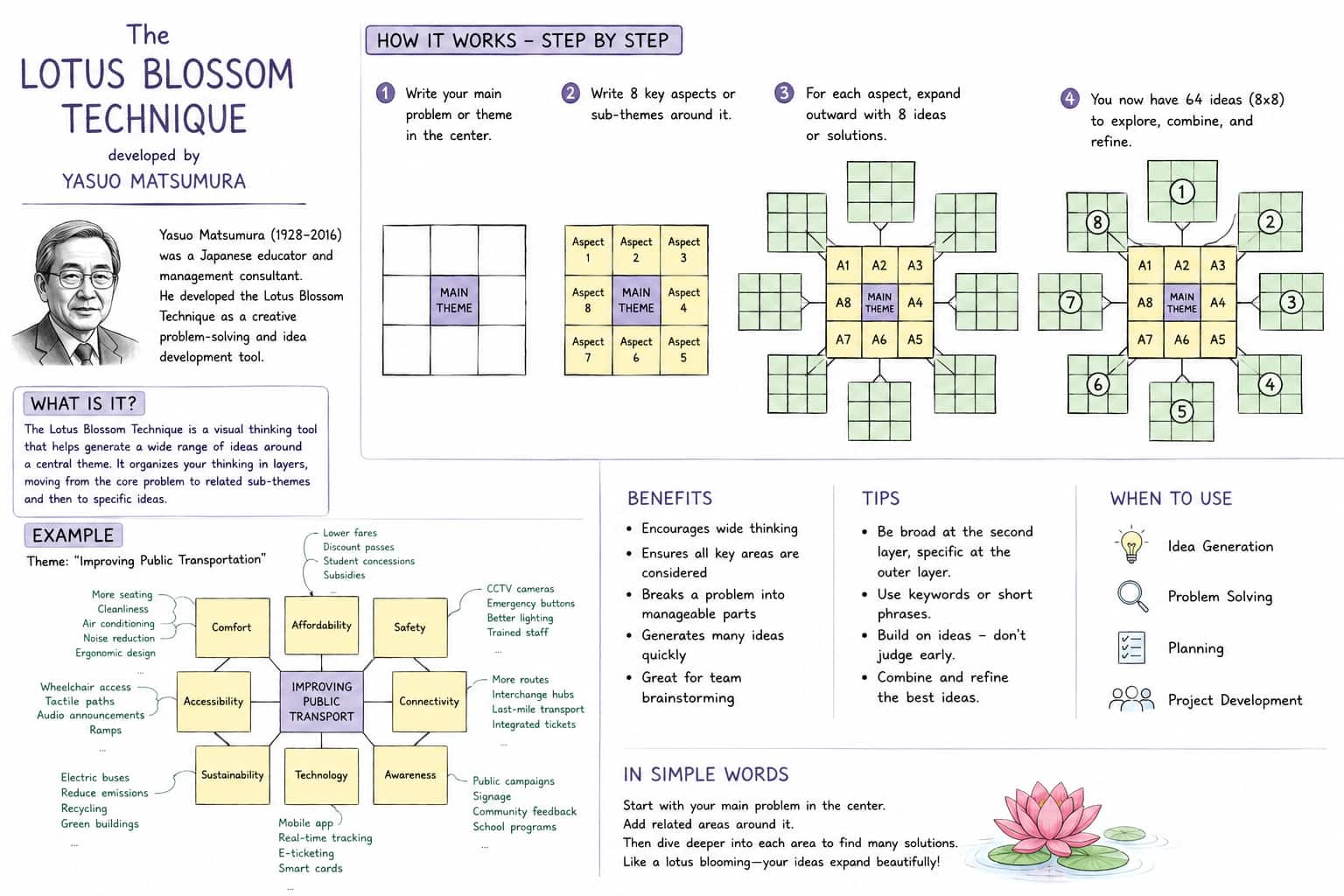
Sample Practise Problem : Using the Lotus Bloom Technique, create the cutlery inspired promoting the idea of “ Reducing, Plastic Waste in College Canteens”
Six-Thinking Hats : Parallel Problem Evaluation
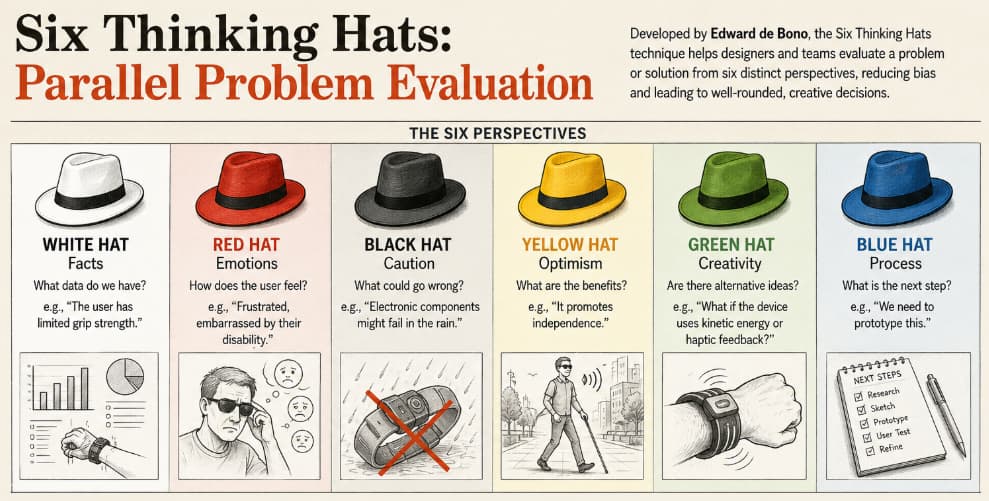
This is Problem-Solving/Design Thinking Technique developed by “Edward-De-Bono” in his book, Six-Thinking-Hats, this technique is used by the corporate boards and design teams for decision making from multiple distinct perspectives. As a design aspirant you can also use this to evaluate your ideas as follows:
White Hat (Facts): what Data do we have?
Red Hat(Emotions): How an User may feel(frustrated, happy etc.)
Black Hat(Caution): What may go wrong? (electronics may fail)
Yellow Hat(Optimism): What are the benefits? (like it promotes independence)
Blue Hat(Process): What is the Next Step ?
Green Hat(Creativity): Can this be solved alternatively ? (What if device uses Mechanical Power)
Example : You have to devise a wearable solution for navigation to be used by “Visually Impaired”. Let’s do the six-thinking hats analysis for the same.

F. Reframe The Problem : Alternative Thinking
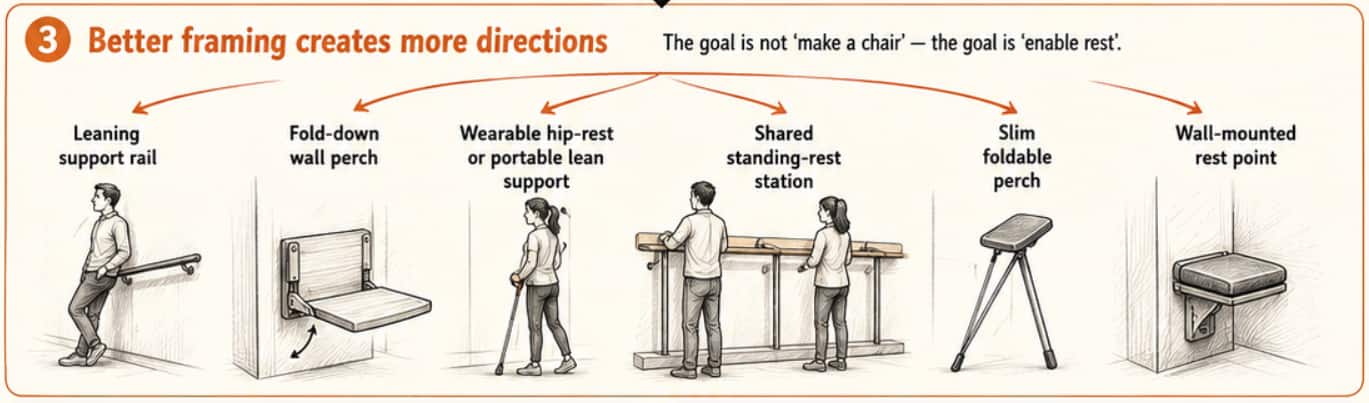
IDEO the pioneers in design-Problem solving heavily focusses on the below analogy of alternative thinking, where they treat the Problem as an opportunity while keeping the solution open for interpretation. So the big question is: “How Might We”?
Example : If we are asked to design a chair for Museum, we immediately think of a traditional chair(a furniture to rest), but the Alternative Thinking as technique emphasise on something more:
How : Might a visitor rest briefly without blocking the circulation or carrying bulky equipment ?
This changes the whole thinking narrative as the solution oriented to make visitors “rest” not exactly sitting or exploring alternatives(support, wearable supports, resting solution) as shown in the image below.
So a strong “alternative-Tinking” mindset should focus on:
A. The user
B. The desired Output
C. The Context
D. The Constraint
Conclusion
To conclude, focus on the “The Process” not the outcome, which will ultimately produce a “Problem-Solving” mindset, with the following abilities to:
Notice what others ignores
Question the primary interpretation
Think Alternative before jumping to solution
Examine the concept from the POV of different users
Test, and improve the idea before presenting it finally
Also Read:
Articles
Related Stories
|
Upcoming Design Exams

Certifications By Top Providers
Explore Top Universities Across Globe
Popular Courses and Specializations
Popular Degrees
List of colleges accepting UCEED
Browse Design Colleges by State
Questions related to UCEED
On Question asked by student community
Have a question related to UCEED ?
You can download the UCEED 2027 GK Questions Preparation Tips PDF from Careers360 here:
https://design.careers360.com/download/ebooks/uceed-gk-questions-preparation-tips
Hello Student,
To start your NID DAT and UCEED preparation, begin with the syllabus, exam pattern, and previous years' question papers. You can also refer to the Careers360 preparation resources and sample papers for regular practice using the links provided below.
Hi Student,
You can practise previous-year UCEED, NIFT and NID questions and check the correct answers or solutions after attempting them. For UCEED, Careers360 provides previous-year papers with answer keys, while NIFT papers are available with solutions. NID previous-year papers with solutions are also available for practice.
You can start
Hello Dear Student,
With UCEED AIR 130 (Open category) and currently allotted IIITDM Jabalpur under the FLOAT option, your chances after Rounds 4 and 5 depend on how many higher-ranked candidates withdraw or move to their preferred institutes.
Based on recent Round 5 Open-category closing ranks:
- IIT Delhi: around AIR
Hello Anvi, as you have to apply for design programs other than NIFT, NID and UCEED. There are various institutions which provides fashion design courses such as, Pearl University , MIT institute of Design , Symbiosis Institute of Design , FDDI , BITS Design School and many more. These colleges

Applications for Admissions are open.
Faculty from A+ Design schools of India and Abroad | 100% Placement Assistance
IIAD Admissions 2027
ApplyLeading Design College | Highest CTC: ₹12 LPA | Average CTC: ₹7.5 LPA | Scholarships for Deserving Students
UPES B.Des Admissions 2027
ApplyRanked #45 amongst Universities in India by NIRF | Get Upto 100% Scholarships | Spot Admissions via CUET
Woxsen University Design Admissions 2027
ApplyOutlook I-Care Top 25 Private Fashion Design Institutes 2026: All India Rank #3 | Highest CTC 10 LPA
SRM University Ramapuram B.Des Admissions 2026
ApplyApplication form FREE of Cost for a Limited Period of Time | #11 by NIRF | NAAC A++ Accredited Institution | 1100+ Recruiters
Creative Edge Design Exam Coaching By Toprankers
ApplyChoose Creative Edge by TopRankers for Design Test Preparation
UCEED Notifications
Never miss UCEED update
Get timely UCEED updates directly to your inbox. Stay informed!